ARGUS multi-eye iconARGUS: Stacked Multi-View Identity Mosaic Injection
for Subject-Preserving Video Generation

Zijie Meng1,2, Jiwen Liu2, Yufei Liu3, Chengzhuo Tong2,
Xiaoqiang Liu2, Yuanxing Zhang2, Yulong Xu2, Pengfei Wan2
1 Peking University    2 Kuaishou Technology    3 Xiamen University
Abstract

TL;DR: ARGUS turns multiple identity observations into compact, time-synchronized diffusion memory for robust subject-preserving video generation.

Subject-preserving video generation is not solved by frontal-face similarity alone: a generated person must remain recognizable across motion, large viewpoint changes, expression shifts, occlusion, scale variation, and conflicts among text, first-frame, and identity references. We argue that the central bottleneck is the point-reference paradigm, which collapses identity into a single static observation entangled with pose, accessories, lighting, background, and camera statistics. We introduce ARGUS, a Wan-based framework centered on Stacked Multi-View Identity Mosaic Injection (SMII). SMII converts MLLM-selected image/video identity evidence into a 3×3 stacked mosaic, synchronizes the mosaic with the current diffusion time, and injects it as negative-time read-only memory in Wan's native token space. This turns identity from an external clean adapter or a single reference image into a compact dynamic distribution. Around SMII, an MLLM Identity Director selects informative identity moments and resolves condition conflicts, while no-cross-pair counterfactual training, Temporal Identity Annealing, and Adaptive Self-Likeness Guidance improve robustness without paired subject-video supervision. ARGUS achieves state-of-the-art results on OpenS2V-Eval Human-Domain and HardID-Celeb, demonstrating robust identity retention under large yaw changes and first-frame occlusions.

Initial Viewpoint & Camera Motion Control
TARS jointly controls the target initial viewpoint and camera trajectory, allowing the camera to begin from a specified viewing angle before following the requested motion. For each example, the left is the reference and the right is the TARS result.
Portrait: First-Person to Third-Person
TARS transforms a portrait video from a first-person observation into a third-person viewpoint while preserving identity, scene context, and temporal motion. For each example, the left is the reference and the right is the TARS result.
Portrait: Third-Person to First-Person
A second portrait setting demonstrates the same third-person-to-first-person transition under a different scene and motion pattern. For each example, the left is the reference and the right is the TARS result.
Animal: Third-Person to First-Person
TARS changes an animal video from third-person to first-person, maintaining plausible subject motion and a coherent new perspective. For each example, the left is the reference and the right is the TARS result.
Robotic Arm Scene
TARS supports viewpoint changes in embodied robotic-arm scenes, preserving the task-relevant scene layout and the arm's temporal motion while moving to a new perspective. For each example, the left is the reference and the right is the TARS result.

More Cases Exploration

Explore additional multi-view identity mosaics and subject-preserving generation results.

More: 3×3 Multi-View Identity Grids
Additional identity mosaics selected from image and video evidence. Each grid compactly captures complementary views and appearances of the same subject.
More: Subject-Preserving Generation
Additional ARGUS results across challenging identities, viewpoints, expressions, and first-frame observations.
More: Portrait: Third-Person to First-Person
Additional portrait third-person-to-first-person transitions in different scenes and motion patterns. Left is the reference, and right is the TARS result.
TARS case slot
Add the replacement media in case/
TARS case slot
Add the replacement media in case/
TARS case slot
Add the replacement media in case/
TARS case slot
Add the replacement media in case/
TARS case slot
Add the replacement media in case/
TARS case slot
Add the replacement media in case/
TARS case slot
Add the replacement media in case/
TARS case slot
Add the replacement media in case/
TARS case slot
Add the replacement media in case/
TARS case slot
Add the replacement media in case/
TARS case slot
Add the replacement media in case/
TARS case slot
Add the replacement media in case/
TARS case slot
Add the replacement media in case/
TARS case slot
Add the replacement media in case/
TARS case slot
Add the replacement media in case/
TARS case slot
Add the replacement media in case/
TARS case slot
Add the replacement media in case/
TARS case slot
Add the replacement media in case/
TARS case slot
Add the replacement media in case/
TARS case slot
Add the replacement media in case/
TARS case slot
Add the replacement media in case/
TARS case slot
Add the replacement media in case/
TARS case slot
Add the replacement media in case/
TARS case slot
Add the replacement media in case/
TARS case slot
Add the replacement media in case/
TARS case slot
Add the replacement media in case/
TARS case slot
Add the replacement media in case/
TARS case slot
Add the replacement media in case/
TARS case slot
Add the replacement media in case/
TARS case slot
Add the replacement media in case/
TARS case slot
Add the replacement media in case/
More: Animal: Third-Person to First-Person
Additional animal third-person-to-first-person transitions. Left is the reference, and right is the TARS result.
TARS case slot
Add the replacement media in case/
TARS case slot
Add the replacement media in case/
TARS case slot
Add the replacement media in case/
TARS case slot
Add the replacement media in case/
TARS case slot
Add the replacement media in case/
TARS case slot
Add the replacement media in case/
TARS case slot
Add the replacement media in case/
TARS case slot
Add the replacement media in case/
TARS case slot
Add the replacement media in case/
TARS case slot
Add the replacement media in case/
TARS case slot
Add the replacement media in case/
TARS case slot
Add the replacement media in case/
Qualitative Comparisons
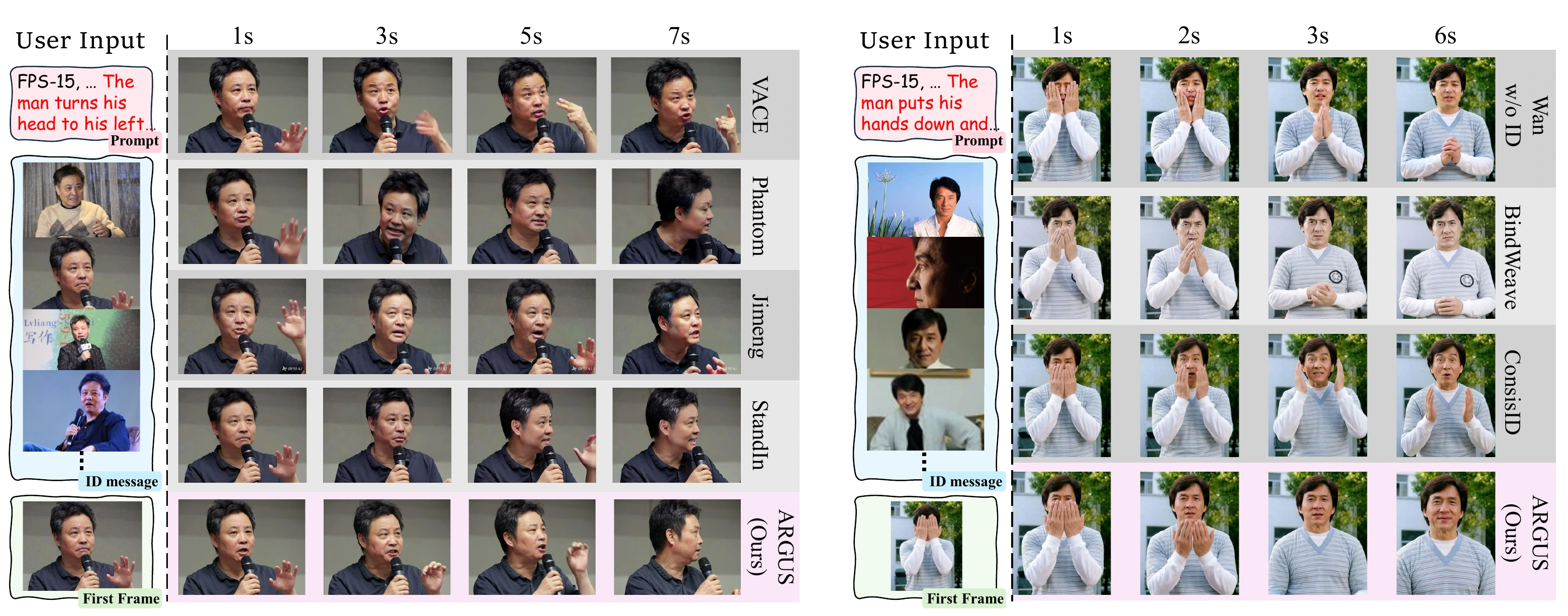
ARGUS qualitative comparison under identity-stress scenarios
Qualitative comparison under identity-stress scenarios. Large-yaw generation: VACE, Phantom, Jimeng, and StandIn can lose side-face identity, become geometrically unstable, or over-smooth facial texture. ARGUS retains sharper identity details while the subject turns. First-frame occlusion: Wan may hallucinate the hidden face without identity injection; ConsisID can degrade under weak first-frame cues; and BindWeave can inherit reference-like expressions. ARGUS recovers identity from the stacked mosaic with natural expression and motion.
Pipeline
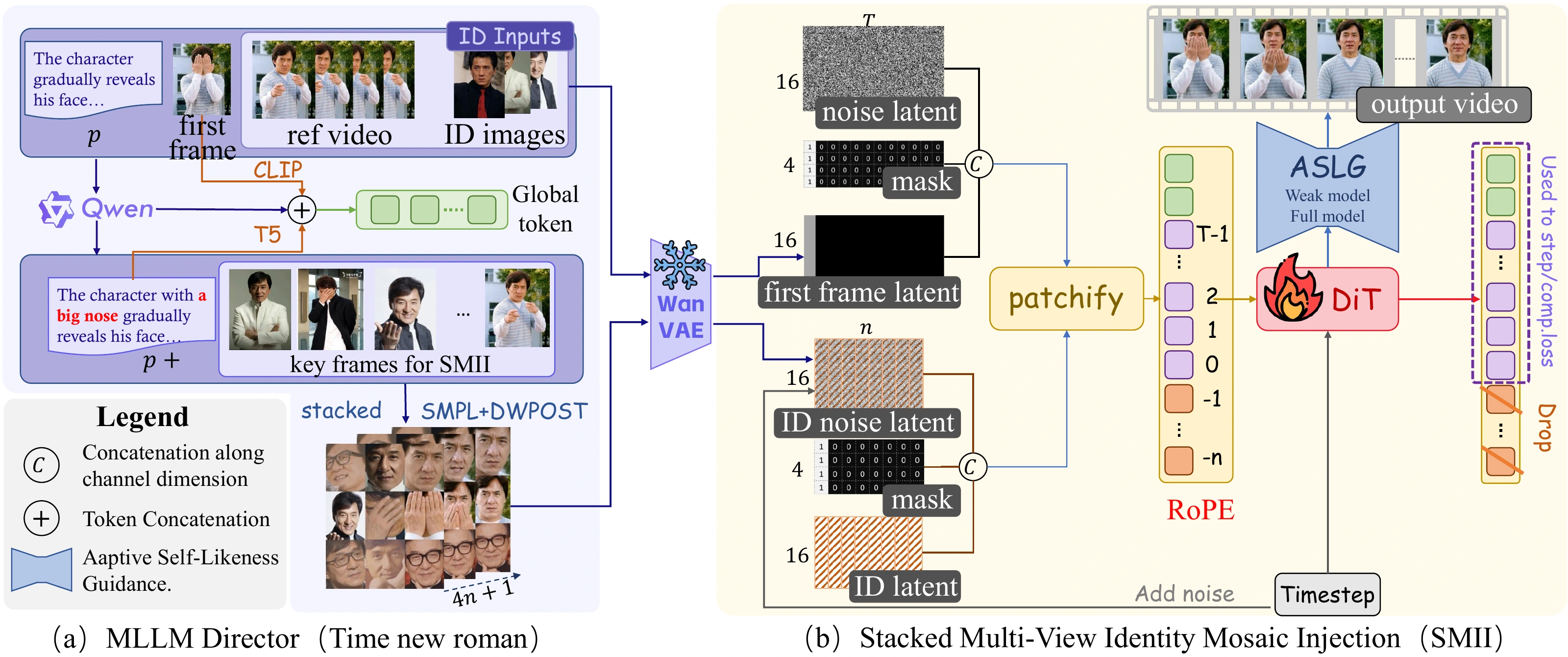
ARGUS stacked multi-view identity mosaic injection overview
ARGUS overview. An MLLM Identity Director compiles dynamic identity evidence from reference images and videos. Stacked Multi-View Identity Mosaic Injection (SMII) arranges selected observations into a 3×3 mosaic, synchronizes the mosaic latent with the current diffusion time, and injects it as negative-time read-only memory tokens. During sampling, Adaptive Self-Likeness Guidance separates text guidance from identity guidance.
Ablation Study
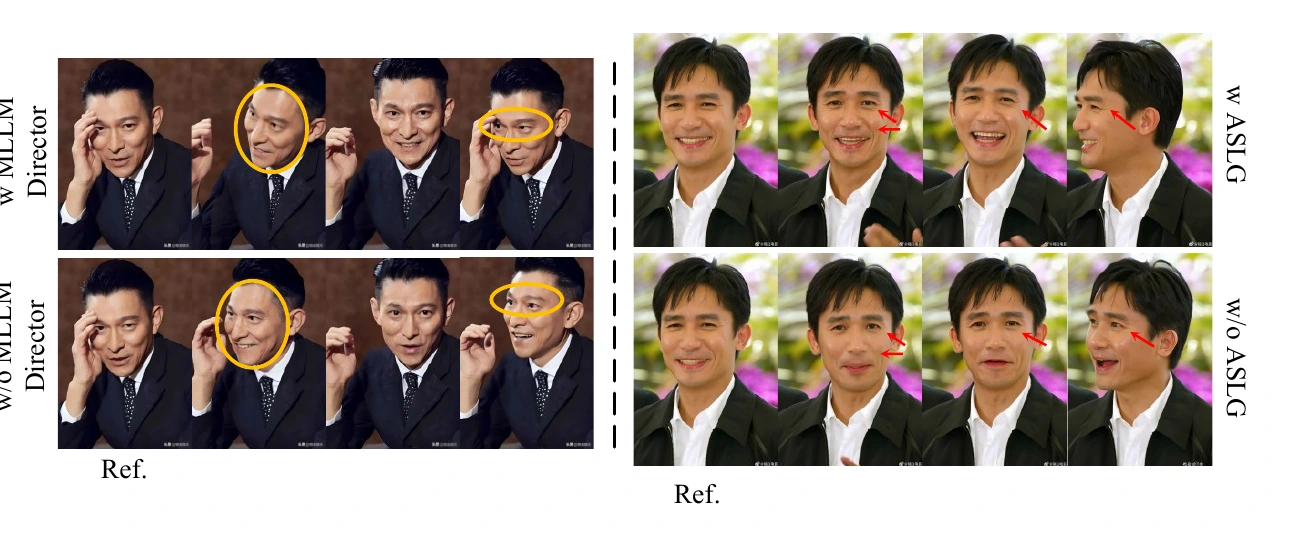
ARGUS ablation on the MLLM Identity Director and adaptive self-likeness guidance
Ablation on the MLLM Identity Director and ASLG. The MLLM Director preserves fine-grained identity details, while Adaptive Self-Likeness Guidance substantially improves identity-specific texture and skin quality.
Acknowledgement
We thank the Kling team, all contributors to the ARGUS project, and the annotation team for their support in data curation and evaluation.
Responsible Use Statement
The examples on this page are intended solely to communicate research results on subject-preserving video generation. Identity-related generation can be misused for impersonation; we use only materials authorized for research demonstration and will update or remove an example when a valid concern is raised.
BibTeX

@article{meng2026argus,
  title={ARGUS: Stacked Multi-View Identity Mosaic Injection for Subject-Preserving Video Generation},
  author={Meng, Zijie and Liu, Jiwen and Liu, Yufei and Tong, Chengzhuo and Liu, Xiaoqiang and Zhang, Yuanxing and Xu, Yulong and Wan, Pengfei},
  year={2026},
  eprint={2606.11670},
  archivePrefix={arXiv},
  primaryClass={cs.CV}
}